

Eat It Before It Buries You
Pigweed / Wild Amaranth

Wild amaranth is the bane of gardens and pastures at weedom. The various species (mostly spiny amaranth and red root amaranth) can take over a plot in about 2 weeks, and bury it in a month. Pulling the amaranth becomes ridiculous within about 5 weeks at which time bush-hogging becomes the preferred option. The 50-70 species of this plant are considered to be edible and medicinal by people in various parts of the world. Our favorite U.S. foragers deem about 20 species to be good eating. But one of the favorites has been cursed, with the red bar, as highly poisonous at the North Carolina Extension site.


This is most certainly an error that they ought to fix, since this weed is a long recognized source of wild greens indigenously and in modern times. This species is food from the Americas to Europe: leaves, stems and seeds. Too many people consume the nitrate accumulating greens as a regular part of their diet, so that this kind of gaffe on the academic website is not a good look.
As for the poison warning, this may be ignored by those who are not grazing pastures during drought as their primary means of nutrition. Perhaps avoid the amaranth around eutrophied ponds and ditches full of fertilizer runoff, if you like to eat this weed a lot. Cows and pigs are more susceptible to overdosing on the amaranths when the grass has been eaten down and the nitrogen accumulating plants, which are drought resistant, predominate. For them, the overdose can cause bloating, abortions, blood disorders, organ failure and death. Farmers have to pay attention to the mix of forage on their fields to prevent toxicity in the animals, keeping these otherwise nutritious weeds to less than 10 percent of the grazing. Like spinach, purslane and lambs quarters (Chenopodium alba), Amaranthus species are high in oxalic acid, so those who are prone to that type of kidney stone will want to avoid large amounts. Remember that oxalic acid is more of an issue for those with low dietary calcium.
Amaranth leaves are sold in farmers markets, and are a commonly used green, cooked or raw, depending on the age and tenderness of the leaves and stems. The taste of our red root species is similar to spinach, and therefore similar to lambs quarters. The aftertaste is a tiny bit more bitter and astringent, but I consider the young leaves and growing leaf tips of any plant, prior to flowering, as tastier than chard. Microgreens of this amaranth could be eaten whole. Young plants have a tender stem that can be eaten unpeeled. It is milder and tastier than the leaves. The spiny amaranth leaves taste similar to red root type, but the shiny, smooth stems have a more distinct grassy taste. The tiny seeds of our 2 main amaranths are too much work, so I rate them as negative calorie food from a personal foraging standpoint. Other amaranth species have bigger seeds that are easier to winnow, but it’s still very labor intensive.
The spiny amaranth relationship here is a sort of love/hate thing. It’s miserable to walk through, and the thorns at every leaf node make it hard to pull without gloves. But I found that it useful to allow some of this to grow among the sweet corn, as an aid to transmit more electricity to the racoons and deer which will otherwise get this food before we do. When we regularly grew sweet corn, we ran electric fence wire between the rows of the personal garden, as a wildlife deterrent, and I noticed that this prickly weed served as a conductor to spread the tingly feeling more efficiently over a wider area. So I allowed its presence among the corn and the wires. Yes, it is truly stimulating to pull a weed that’s touching the electric fence, and I knew that this could have benefits. But spiny amaranth is tingly all by itself. two spines emerge from the stems at each leaf node, and these are always spaced too closely to grab the smooth stem between them. This guarantees pulling or harvesting to be an extra special experience. Wear gloves. Though smaller than the leaves of red root amaranth, they’re decently edible too.
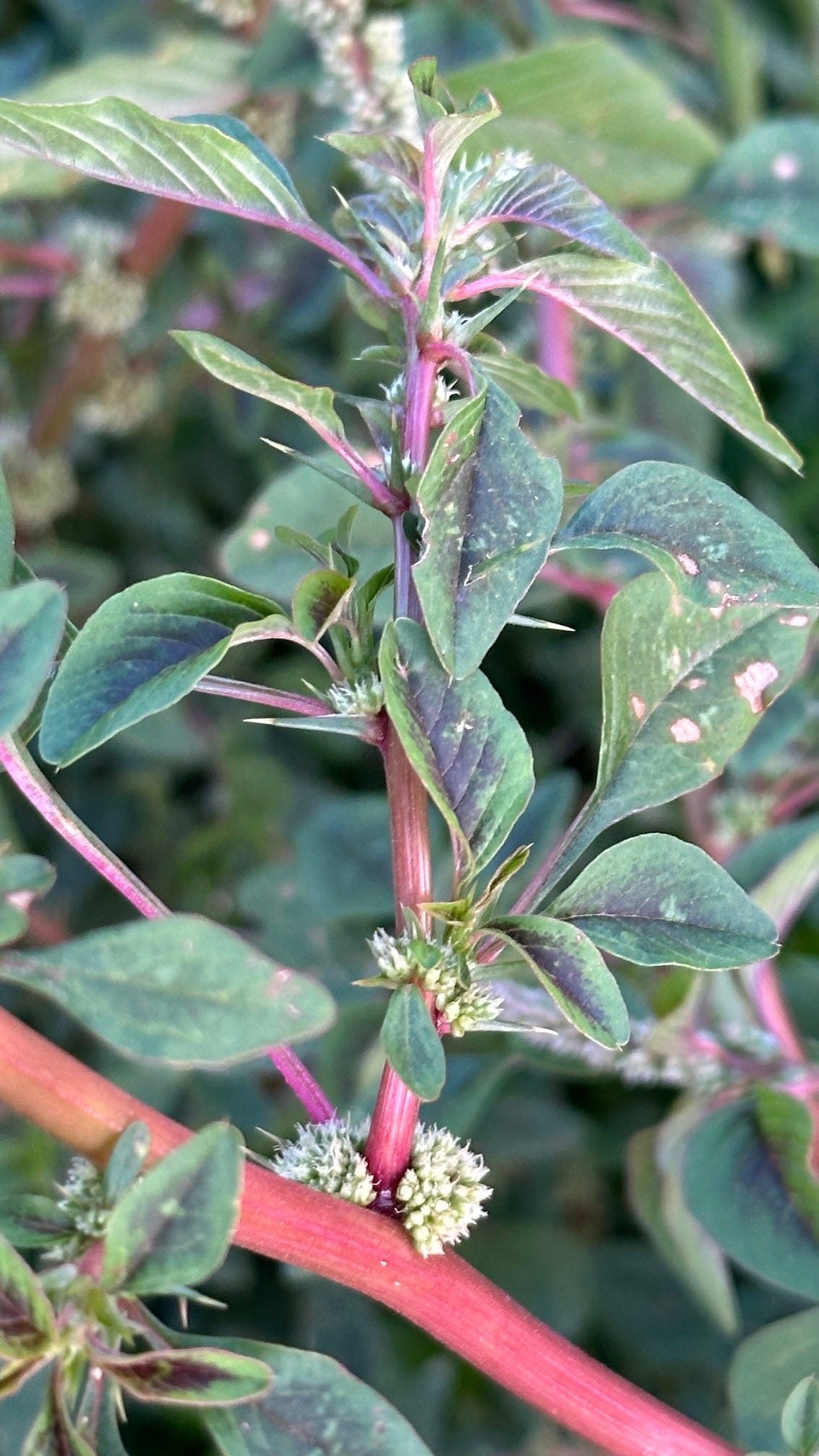
The size of amaranth plants when they flower is hugely variable. No matter the size, once it flowers, the stems get tough, and the leaves become more bitter. Apparently the nitrate concentrations drop, however. :-D Moral of the story: whatever food tastes best has to be rationed.
The distribution of our 2 weeds is quite extensive, and almost every part of the world from USDA hardiness zones 3-11 has their own native amaranth. Types of amaranth grown for seed, such as Amaranthus cruentus, have been in use for thousands of years. It is thought that middle to eastern North America has gifted much of the rest of the world with Amaranthus retroflexus, which rapidly grows from about 1 to 2 meters or more, and matures within 8 weeks to spread many thousands of seeds everywhere. The roots of this plant may reach even more deeply than its aerial height, allowing it to be practically the last weed standing during drought. Apparently the tiny dark seeds of this plant are not so tenacious, lasting only 5-6 years in the soil, but sheer volume of production makes up for this. So, thank you, Asia for the lantern flies, beetles, and honeysuckle, and we hope you are enjoying our vigorous and potent red root amaranth :-D
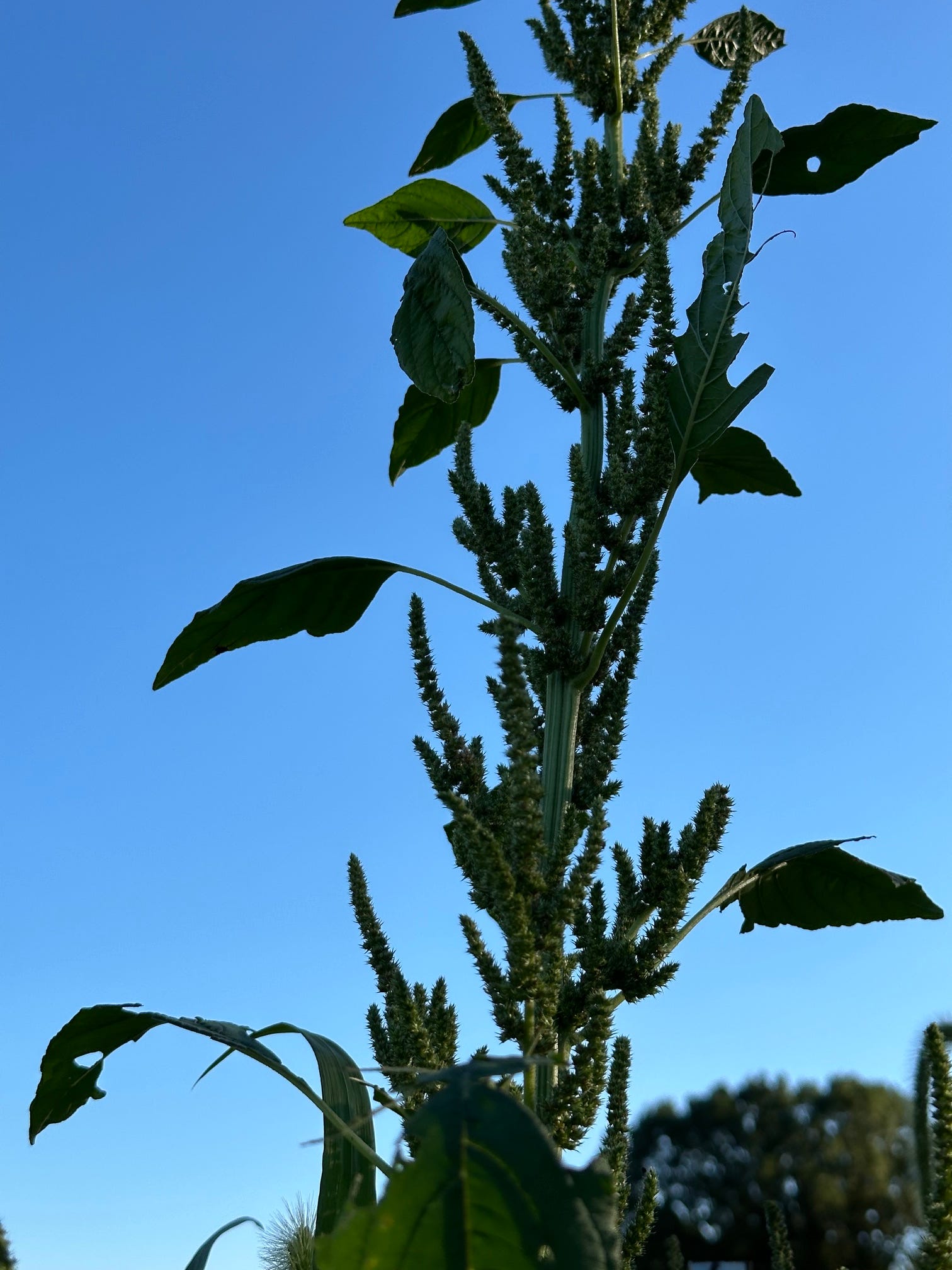
Amaranth plants belong to the Family Amaranthaceae, which is now said to include the Chenopodium, lamb’s quarter, species. The similarity of these plants is readily apparent in our fields. The prominently veined leaves of red root amaranth with their long petioles, emerge in alternating pattern around the stem. New growth or flowers can emerge from the leaf axilla. Veins are depressed above and protrude below the leaf, extending from a central vein in pinnate fashion. Hairs are apparent on the lower side of the leaf veins. Leaves may reach up to 6 inches in length, and their petioles can be of similar length, though both become smaller at the flowering tops of the stems.
Ribbed stems of the plant have very short hairs or may be hairless. They can be eaten, peel and all, when the plants are young. . Microgreens or minigreens can be eaten, roots and all.
Flowering occurs in summer and fall (later than our spiny amaranth). Both male and female (monoecious) flowers occupy the same spikes or panicles of redroot amaranth. They’re tiny, green, with bracts that are longer than the tepals. Each fruit (achene) produces a single dark glossy seed, which may be black to red brown. Since each plant can produce 100,000 or more seeds, we and the rest of the world are assured plenty of this annual weed. If you take the trouble to winnow the seeds you can eat them, ground as flour, roasted or cooked.
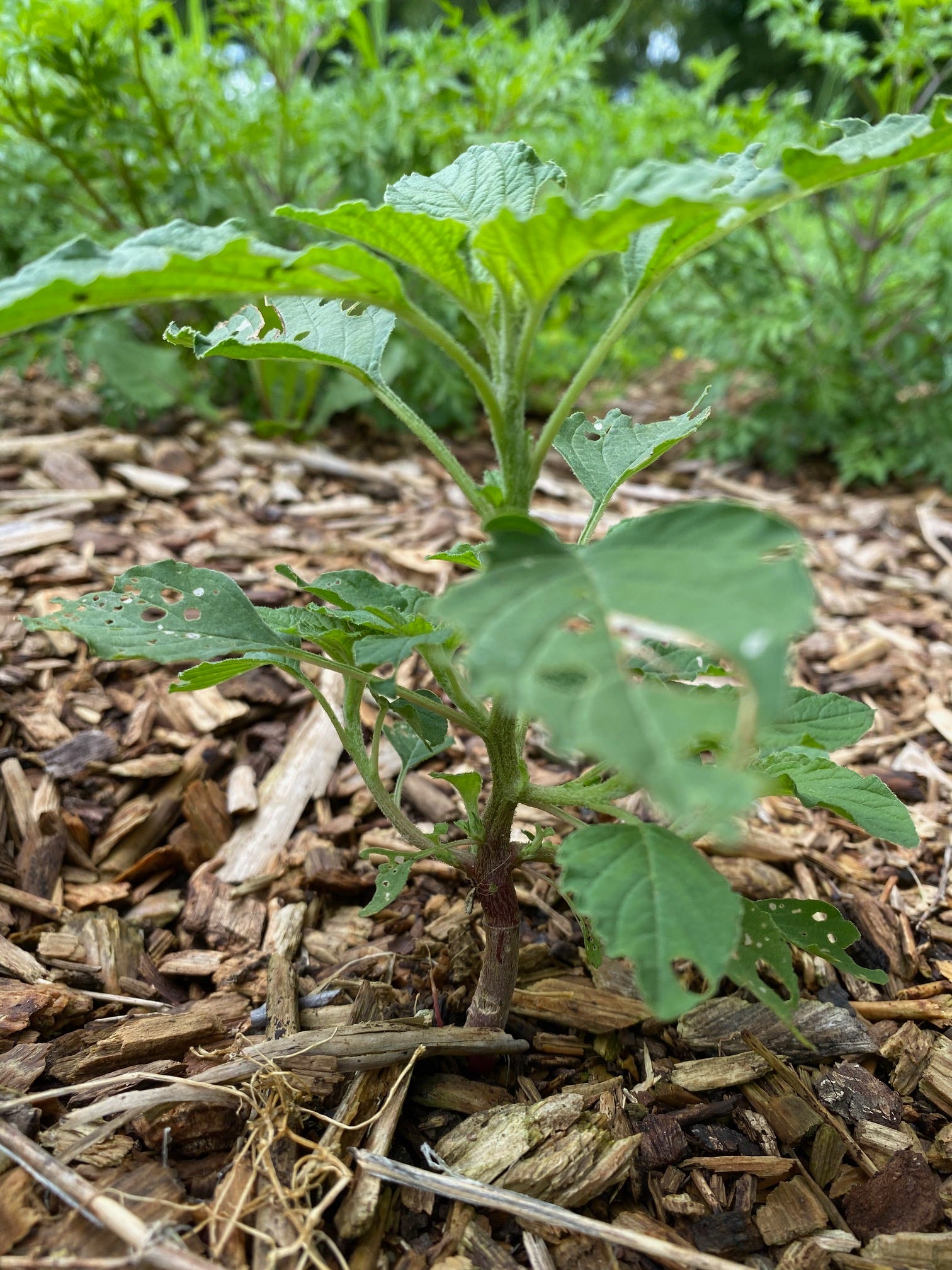
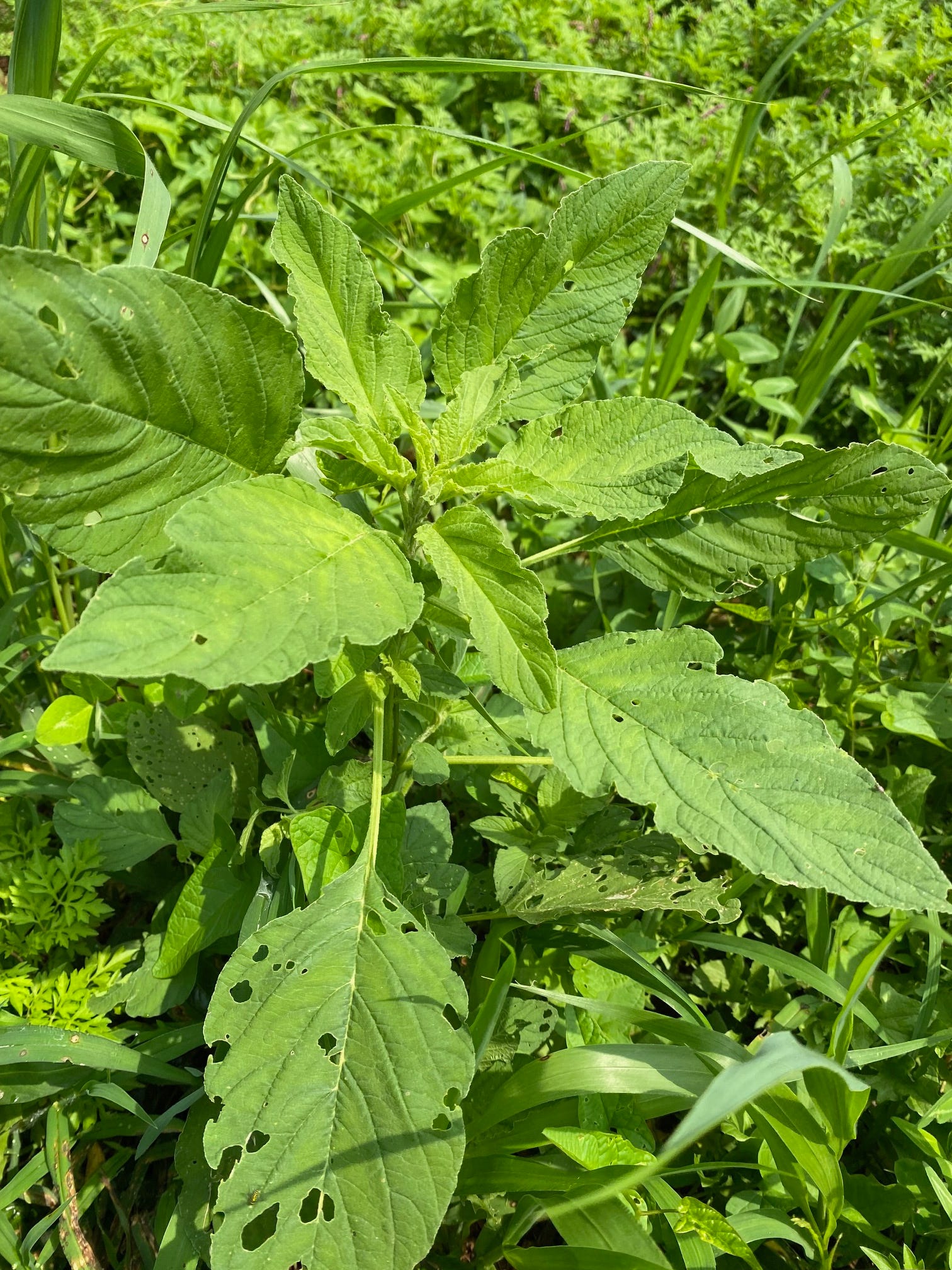
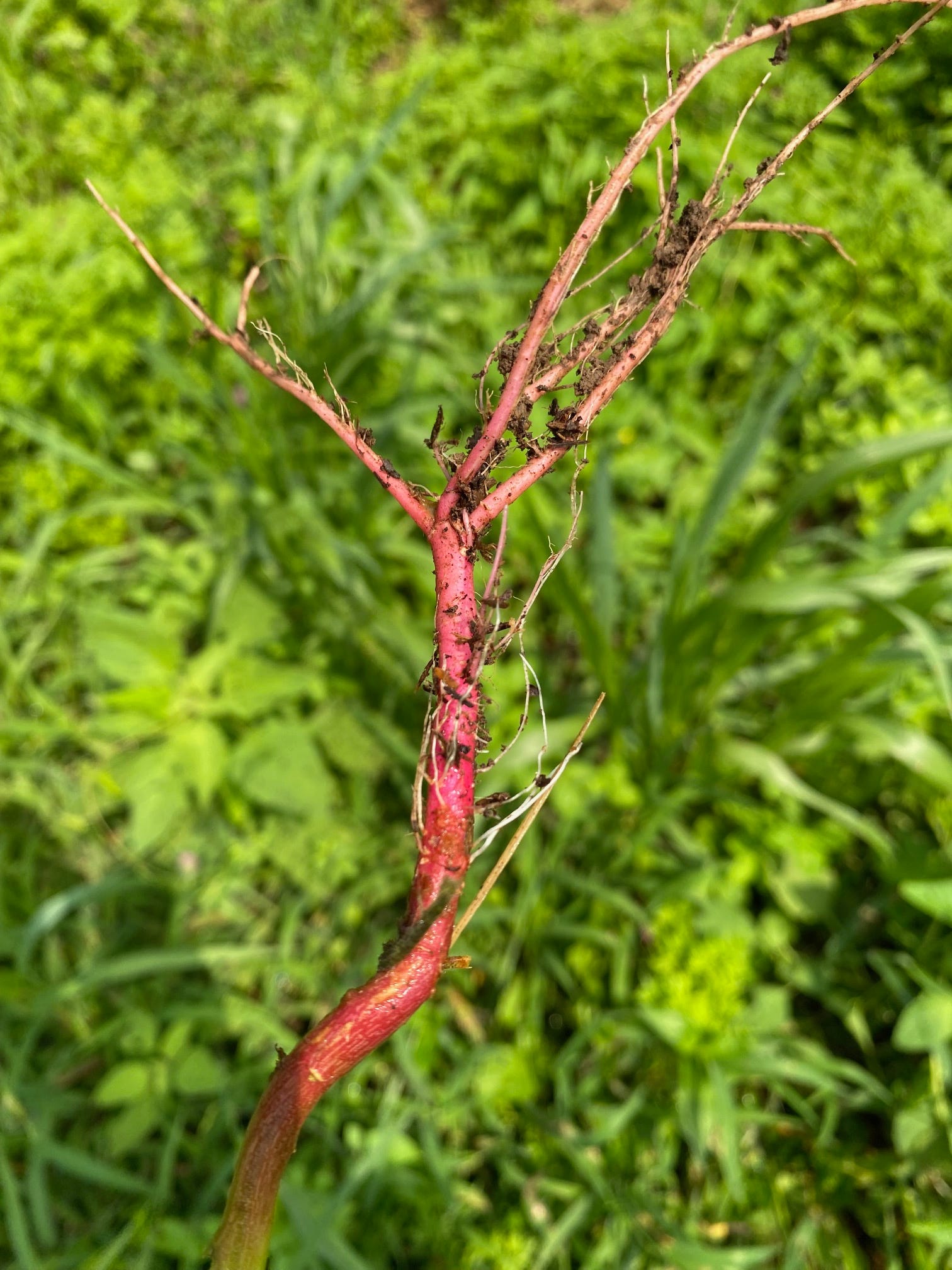
The spiny amaranth, Amaranthus spinosus, with its smaller leaves is not as easy to harvest, but if it’s the one you have, shame to waste. It’s a gift from the tropical Americas to the world, extending from USDA zones 4-11. It shows up at weedom early in summer, and grows to flowering stage quickly, so the harvest time is shorter. Though it’s highly nutritious, I regard this plant overall as edible in smaller quantities, as it has had wide, traditional medicinal use around the warmer portions of the world. The root is regarded as edible by some, but it’s also been used to stimulate menstruation and even as an abortifacient, so it’s not for pregnant women, or those wanting to get pregnant.
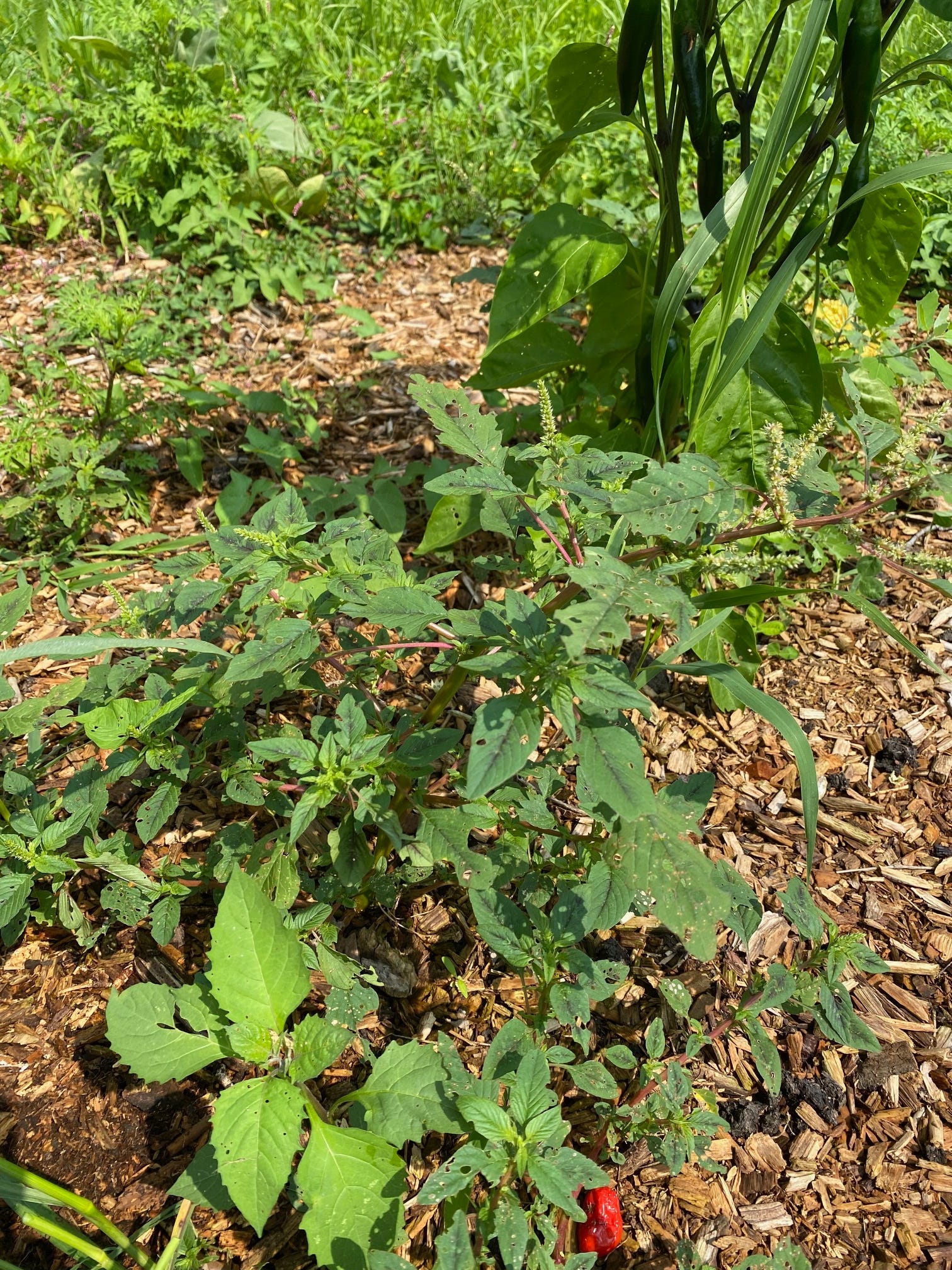
This plant normally hugs the ground at a level of 2 feet or below, but can grow much larger in the tropics. Here it seems to show the common amaranth leaf notch at the tip more prominently, and a pigmented, sometimes chevron pattern can be seen on older leaves. The narrower leaves have pinnate venation, are smoother than the red root amaranth, with shorter petioles. Betalain pigments are apparent in the leaves, stems and roots, as with our red root and many other amaranths.
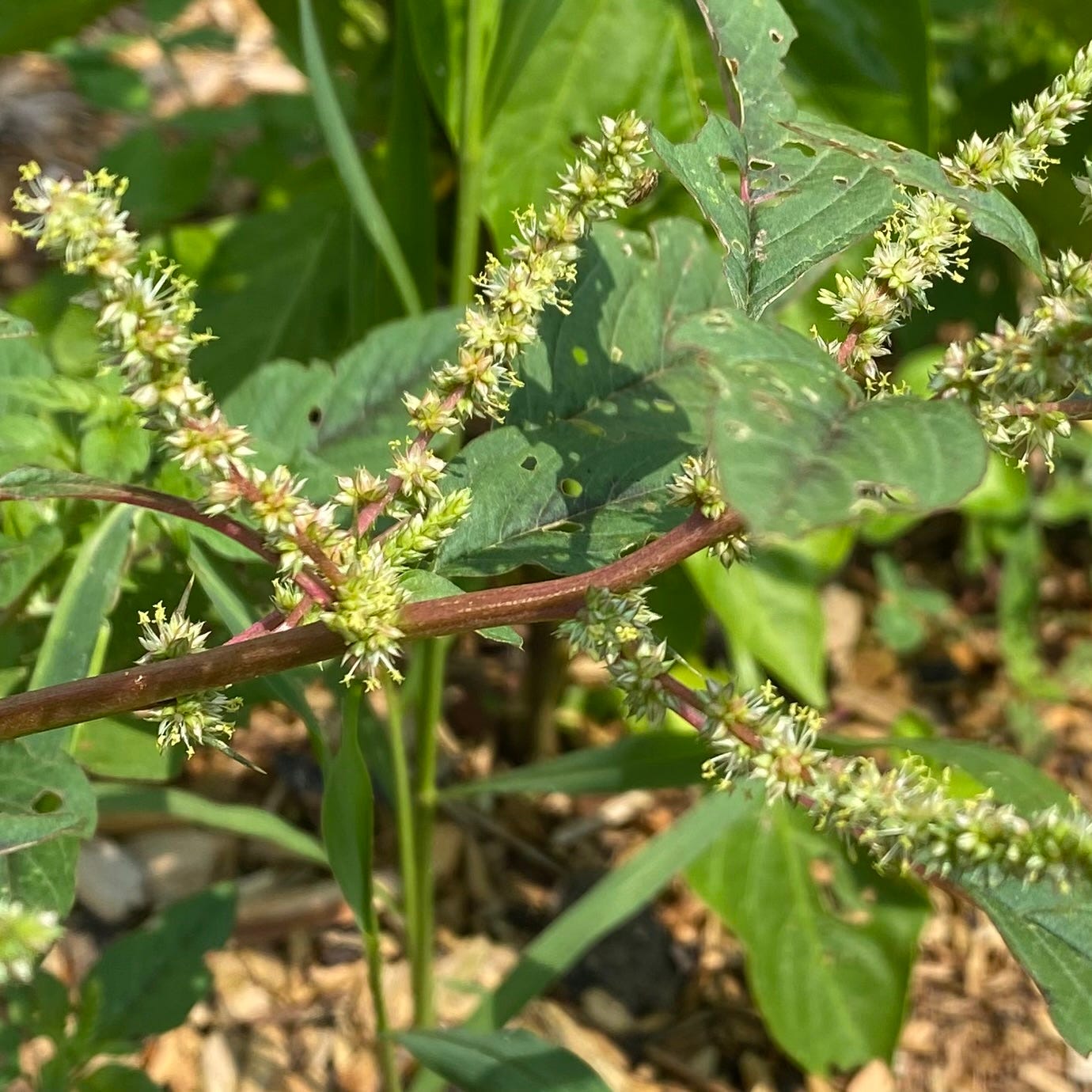
Male flowers occupy the spikes, and triple-pistillate female flowers are nestled in the leaf axilla, partially concealing the pairs of spines projecting at each leaf node. Each plant can produce over 100,000 tiny, dark seeds, which are edible if you want to work hard to clean them.
Motivating us to add amaranth leaves to our mixed greens is their high nutritional content. The dry weight of the leaves is comprised of 13-20 percent protein, much of which is lysine. Plenty of vitamin A, and C, potassium, magnesium, phosphorus, and iron are present. As with lamb’s quarters, we can put it wherever the spinach, kale, collards and mustard go. In India, amaranths can go into the saag and thoran, and be spiced up as needed. Being comparatively bland at weedom, our greens get less heat, although some jalapenos and poblanos have been dropped in there from time to time. Here at the end of July the spiny amaranth has become ‘a bitter’, as it is flowering, and the red root amaranth is still a bulk vegetable, with usable stems and leaves. Purslane and heal-all are at peak, and lamb’s quarter tops are still available for cooking. It’s so wet this year that we can still eat the violets, broad leaf plantain, mallow, and even dandelions.
As a practical matter, red root amaranth should be picked shortly before preparation, or else you need to rehydrate it in water to give it some body. It tends to wilt pretty quickly. You can also blanch and freeze it, or refrigerate it for later use.
Wishing our loyal readers happiness this summer from weedom, where the rain is now so plentiful that we’re overgrown with bugs, and weeds, and the trees are getting a long needed drink. As always, you’re invited to weigh in with your amaranth questions and experiences. A chat thread and comments are fully open.
Where We Dig
1. Fiorito S, Epifano F, Palmisano R, Genovese S, Taddeo VA. A re-investigation of the phytochemical composition of the edible herb Amaranthus retroflexus L. Journal of Pharmaceutical and Biomedical Analysis. 2017;143:183-187. doi:10.1016/j.jpba.2017.05.051
2. Singhal RS, Kulkarni PR. Amaranths–an underutilized resource. Int J of Food Sci Tech. 1988;23(2):125-139. doi:10.1111/j.1365-2621.1988.tb00559.x
3. Amaranthus retroflexus (Redroot Pigweed): Minnesota Wildflowers. Accessed July 31, 2026. https://www.minnesotawildflowers.info/flower/redroot-pigweed
4. Amaranthus spinosus - Useful Tropical Plants. Accessed July 31, 2026. https://tropical.theferns.info/viewtropical.php?id=Amaranthus+spinosus
5. Long B, Jiang C, Liu Z, Wan P, Guo Q. Association of dietary nitrate and nitrite from plant sources with digestive system cancer risk: a systematic review and meta-analysis. Nutr Metab (Lond). 2025;22(1):84. doi:10.1186/s12986-025-00973-6
6. Bergo A. Common Amaranth: Amaranthus retroflexus. Forager | Chef. July 4, 2018. Accessed July 27, 2026. https://foragerchef.com/common-amaranth-amaranthus-retroflexus-friends/
7. Jordan D. Eat the Weeds: A Forager’s Guide to Identifying and Harvesting 274 Wild Foods. Adventure Publications; 2023.
8. Padmanabhan S. Madappalli - Temple’s Kitchen: Cheera Thoran/ How to make Kerala Style Amaranth Leaves Stir Fry. Madappalli - Temple’s Kitchen. March 1, 2019. Accessed July 31, 2026. https://sadhanakitchen.blogspot.com/2019/03/cheera-thoran-how-to-make-kerala-style.html
9. Ganjare A, Raut N. Nutritional and medicinal potential of.
10. Deane G. Palmer Amaranth. Eat The Weeds and other things, too. December 5, 2010. Accessed July 27, 2026. https://www.eattheweeds.com/palmer-amaranth/
11. Thayer S. Sam Thayer’s Field Guide to Edible Wild Plants of Eastern & Central North America. Forager’s Harvest; 2023.
I was recently on a short road trip and saw lots of amaranth on the side of the highway almost ready to harvest seeds! I almost stopped. Haha. Yeah, it is amazing how many edible plants have been classified as weeds or invasive species. Especially ones that are native to the area (I get it when something gets started from another area of the country/world).
Almost makes a person believe that "they" don't want us to have free food....
Thanks for the rundown! In Jamaica, it's called callaloo. It is typically cooked with salted cod, onions and a bit of tomato and served with boiled, buttered green bananas. YUM! Several varieties of it grow in my desert-like conditions, but mostly the seedy or spiny kind. Trying to grow large leaf varieties.