

Roasting on an Open Fire? Not.
Buckeye, Horse Chestnut

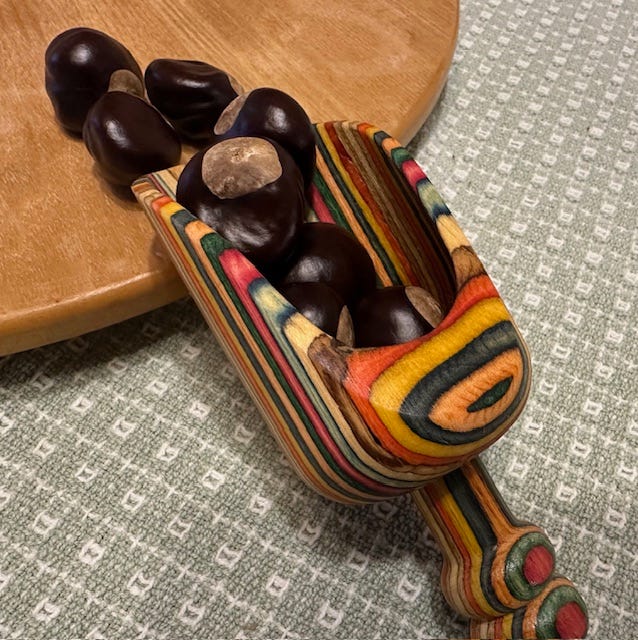
Bitterly full of of saponins, our buckeyes are not the famous nuts of Christmas seasonal lyrics. Although the fruits of many Aesculus species can be processed into a somewhat edible state for humans, it takes a lot of work. However some very hungry groups of people have taken the trouble to roast and chop the innards of buckeyes, and soak them for prolonged periods in water or limed water to remove some of the bitter toxic elements, and eat them. They have also been processed by heating, soaking and grinding, and used in limited quantities to feed to livestock. Pigs have been said to reject this product entirely. Some are of the opinion that after sufficient cooking and rinsing to render the buckeyes palatable, little is left of the nutrients, and the remainder is mostly starch. Among wildlife, it is said that squirrels are fairly tolerant of them, but it’s not their number one food. Conflicting reports about deer eating buckeyes or hating them might be due to confusion between buckeye and the related, sweet chestnut trees (Castanea species) which yield the nuts for roasting. However the squirrels must have been extra hungry this fall, because I’ve been seeing empty outer shells but no buckeyes on the ground. The ravenous squirrels have also braved the territory of the cats of weedom to gather black walnuts during the last few years.
Just about every plant which is unpalatable or inedible has medicine in it, and the horse chestnut and buckeye trees are no exception. The bark, leaves, roots and flowers have all been employed medicinally in various parts of the world. In the U.S., a well known supplement called Venastat was comprised of an extract of the seeds of Aesculus hippocastanum from which the aesculin had been largely removed. The primary active constituent is a mix of triterpene saponins called Aescin. This substance works by various mechanisms to support the integrity of blood vessel walls. It is available generically and under many brand names as an orally available supplement or for topical application.
The temperate regions of the the northern hemisphere , (USDA hardiness zones 3 to 9) support members of the Aesculus genus, recently adopted into the Sapindaceae, a.k.a. soapberry family. Six Aesculus species are native to North America, and 7-13 more species occupy Europe and Asia, along with some hybrids. The Acer, or maple genus, with over 100 species, has also been added to the soapberry family. In the western world, Aesculus hippocastanum, the horse chestnut of Europe is perhaps most famous of its genus. It is thought to have traveled from northern or central Asia through Europe and made a comfortable home for itself in the UK. Traditional medicinal uses likely propelled the migration of this tree to it’s cushy home, with sun, but not too much.
Buckeye trees like morning and evening sun most, but when growing without some cover, tends to get leaf scorch in summer that we see on our trees at weedom. They turn brown and give up early, rather than developing yellow shade that might otherwise occur in the fall.
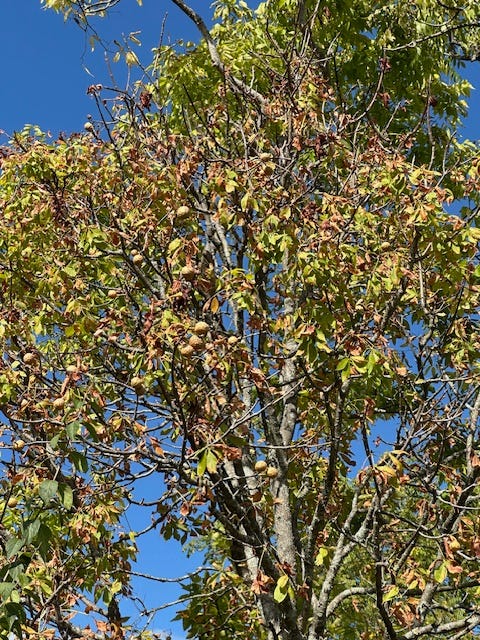
Our main species is Aesculus glabra, the Ohio buckeye, which occupies much of midwestern U.S. flyover country, and can hybridize with the larger Aesculus flava, yellow buckeye. Our local tree grows to 20-40 feet (6-13 m.) while yellow buckeye reaches 40-60 feet (13-19m) and the hybrid is a variable 30-70 feet (10-16m.) at maturity. A. hippocastanum, the horse chestnut, is as tall as the yellow buckeye tree.
As the name A. glabra implies, the palmately compound leaves of the Ohio buckeye are hairless with usually 5 leaflets, which have pinnately arranged veins, and finely serrated margins. Leaves of A. flava are similar but tend to be larger, as are those A. hippocastanum, which may more frequently show up to 7 leaflets. Crushing the leaves of the Ohio buckeye produces an unattractive “fetid” odor which is not such a prominent feature of the yellow buckeye tree.
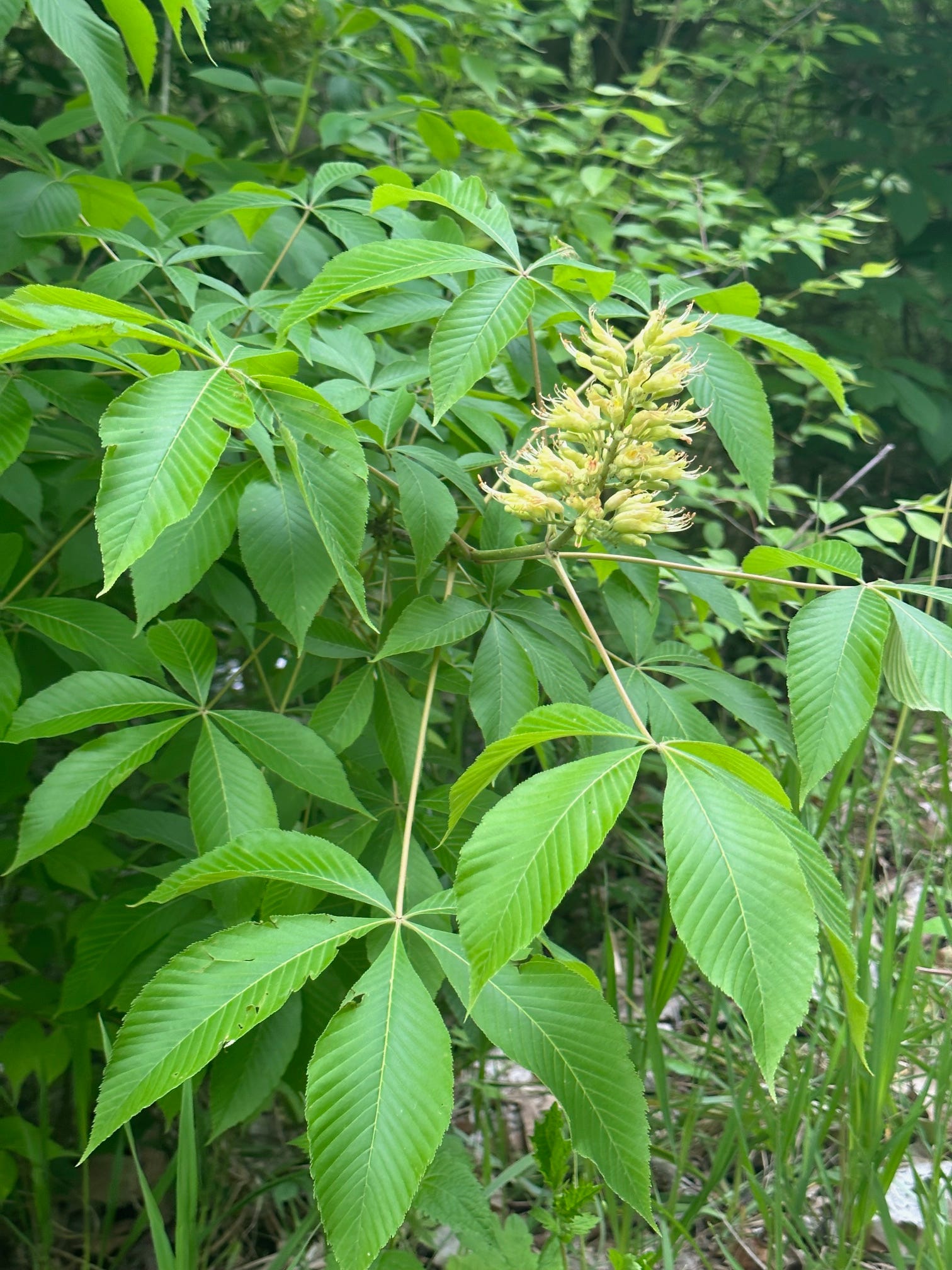
Our spring-blooming tree puts out sweet scented, tubular, 4 petaled flowers arranged on panicles at the tips of the branches. Flowers at the top of the panicle are male, and the lower blooms have both male and female parts. Four stamens protrude from each creamy or yellowish green bloom. (The stamens of yellow buckeye, as well as the hybrid, do not protrude from the blooms.) The panicles may be up to 8 inches (20 cm.) long, while the blooms are 1 -2 inches (2.5-5 cm.) in length.
Fruits are yellowish to brown, leathery and may have warts as ours do, or short spikes like those of horse chestnut. Each 2-3 inch diameter fruit capsule opens in fall to reveal 1-3 shiny dark brown seeds. A prominent lighter colored scar on each seed marks where it attached to the interior of the fruit. .


While all the parts of this tree have had traditional medicinal use, the fruits seem to remain of highest interest for obtaining extracts used in supplements.
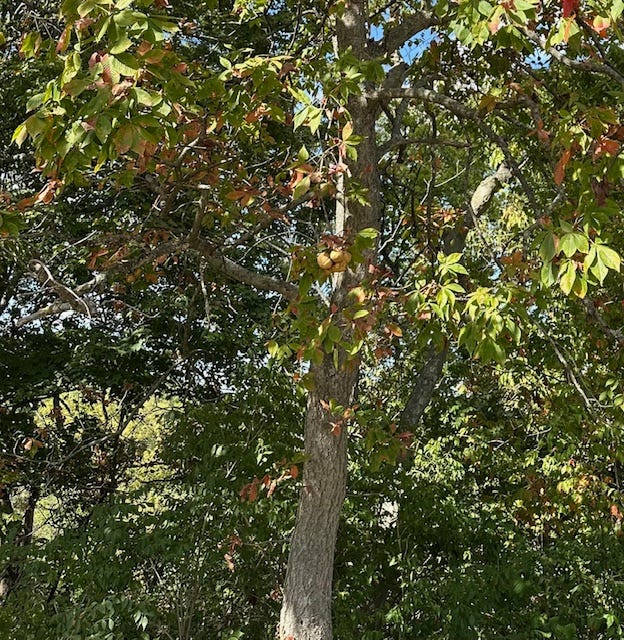
The bark of the tree is distinctly grey, and develops prominent fissures as it ages. Bark of this tree has been traditionally used as a tea to treat malaria, dysentery, and skin ulcerations. The wood of the Aesculus trees is easily worked and light, but not suited long term for heavy structures. So it has been used for artificial limbs in the past, and for constructing smaller items, carvings, and packaging.
Plant saponins from this tree have had application as a soap substitute, but the characteristic odor of certain species prevented this from being a favorite application.
Medicinal applications of our New World buckeyes have been similar to those of A. hippocastanum in Europe, owing to their similar array of constituents. Kings American Dispensatory (Felter and Lloyd) regarded the Ohio buckeye as a generally stronger version of horse chestnut, with applications in non paroxysmal asthma, bronchial irritation with constriction, hepatic congestion, intestinal irritation, chronic constipation, rectal tightness, and hemorrhoids. The older references refer to an opiate like substance within Aesculus bark or the rind of the fruit, even suggesting that it is about 1/3 the strength of opium. A search of the constituents hasn’t revealed one which acts upon recognized opiate receptors. Perhaps the analgesia caused by other mechanisms, including anti-inflammatory activities was confused for opiate action in a time when much of the population was freely partaking of opium derived substances.
Horse chestnut, A. hippocastanum bark extract has made its way into the cosmetics industry to address cellulite, as a skin protectant and for “cellular renewal”. The seed extract is used topically to heal skin, as an astringent and antioxidant, and to strengthen skin capillaries due to its anti hyaluronidase and anti collegenase activities. In other words, the enzymes that break down the intracellular matrix of skin and blood vessel walls are inhibited, thereby preserving structural integrity.
Jump up and down for joy, because the most studied buckeye tree molecule that contributes to its efficacy, as well as the one which is removed from commercial extracts will be presented. :-D
First let’s ponder the Aesculin or esculin which is the troublesome molecule that is normally removed from final products derived from Buckeye. This has a coumarin type of structure which inspires all sorts of warnings that it could interact with blood thinning drugs. The molecule is related to those warfarin type blood thinners which affect vitamin K mediated blood clotting mechanisms. Though Aesculin has a huge array of medicinal effects of its own, (including the reduction of insulin resistance, antimicrobial, anti-cancer and sunscreen properties), it is not as well studied in humans as Aescin. Eliminating this from medicinal extracts of the horse chestnut avoids significant drug interactions and issues with blood thinning.
The most favored substance among numerous useful constituents is aescin or escin, which is a mixture of fairly large, pentacyclic (5 ring), triterpenoid (30 carbon atoms), saponin isomers. The most active isomer is beta-escin, and another less active one is kryptoescin. A trisaccharide, comprised of glucose, galactose and xylose, is attached to the 3 hydroxy end of the triterpenoid structure. The 22 and 21 positions on the other end are esterified with angelic, acetic or tiglic acids. So a variety of closely related molecules are extracted together, and utilized as a supplement with the most active constituent being the β-escin, which has acetic acid and tiglic acid at the 21 and 22 positions. This is a fairly water insoluble molecule of 1131.27 molecular weight. Though absorption of these large molecules from the GI tract is fairly low, their activity to counteract damage, and to increase the integrity of blood vessel walls is significant. Saponins are known in high doses to cause hemolysis due to membrane effects upon the red blood cells. Though this is not a common issue at therapeutic doses of the escin extracts, it is a very serious reason to avoid too much of a good thing.
Escin acts to
inhibit release of inflammatory mediators after blunt force trauma or injury
modulate sensitivity of smooth muscle to calcium ions and increases blood vessel tone and sealing of capillary walls
reduce pain via anti-inflammatory effects
inhibit the enzymes hyaluronidase, collagenase and elastase, thereby preserving intracellular matrices
increase integrity of vascular walls, thereby decreasing permeability from effects of bradykinin.
By the above mechanisms, damage, swelling and pain from injury are decreased. These mechanisms also contribute to the demonstrated efficacy of Escin in addressing leg pain and swelling from chronic venous insufficiency. Numerous products that are touted to be Aesculin free are available on the market. Most standardized to 16-22 percent Escin extract. A dose of 300mg twice daily of a 16.7 % product will deliver 50mg twice daily of Escin, for example. For issues with venous insufficiency and leg swelling, pregnant women should avoid this product and stick with the support hose.
Topical products containing 2% escin extract are also available for such conditions as hemorrhoids, skin trauma, and for cosmetic purposes.

Hope you enjoyed a foray into the chestnut relatives that you won’t be roasting over an open fire. Remember medicine is almost everywhere, and that the difference between medicine and poison is the dose.
Wishing you Happy holidays, Merry Christmas, excellent New Year from snowy and wet weedom-land.
Where We Dig
1. Aesculin - (Horse Chestnut). Accessed December 18, 2025. https://www.chm.bris.ac.uk/~paulmay/webprojects2001/gerrard/aesculin.html
2. Aesculus flava (Big Buckeye, Sweet Buckeye, Yellow Buckeye) | North Carolina Extension Gardener Plant Toolbox. Accessed December 18, 2025. https://plants.ces.ncsu.edu/plants/aesculus-flava/
3. Aesculus glabra (Buckeye, Fetid Buckeye, Horse Chestnut, Ohio Buckeye) | North Carolina Extension Gardener Plant Toolbox. Accessed December 18, 2025. https://plants.ces.ncsu.edu/plants/aesculus-glabra/
4. Aesculus hippocastanum. The Naturopathic Herbalist. October 19, 2011. Accessed May 6, 2025. https://thenaturopathicherbalist.com/herbs/a-2/aesculus-hippocastanum-horse-chestnut/
5. Aesculus hippocastanum Horse Chestnut, European Horsechestnut, Common Horsechestnut PFAF Plant Database. Accessed December 18, 2025. https://pfaf.org/user/plant.aspx?LatinName=Aesculus+hippocastanum
6. Owczarek A, Kołodziejczyk-Czepas J, Marczuk P, Siwek J, Wąsowicz K, Olszewska MA. Bioactivity Potential of Aesculus hippocastanum L. Flower: Phytochemical Profile, Antiradical Capacity and Protective Effects on Human Plasma Components under Oxidative/Nitrative Stress In Vitro. Pharmaceuticals (Basel). 2021;14(12):1301. doi:10.3390/ph14121301
7. Gallelli L. Escin: a review of its anti-edematous, anti-inflammatory, and venotonic properties. Drug Des Devel Ther. 2019;13:3425-3437. doi:10.2147/DDDT.S207720
8. PubChem. Esculin. May 6, 2025. Accessed May 6, 2025. https://pubchem.ncbi.nlm.nih.gov/compound/5281417
9. Hippocastanum.—Horse-Chestnut. | Henriette’s Herbal Homepage. Accessed December 18, 2025. https://www.henriettes-herb.com/eclectic/kings/aesculus-hipp.html
10. Horse Chestnut – Herb Uses and Benefits. The Herbal Resource. June 19, 2019. Accessed December 19, 2025. https://www.herbal-supplement-resource.com/horse-chestnut-herb-benefits.html
11. Cai T, Cai B. Pharmacological activities of esculin and esculetin: A review. Medicine. 2023;102(40):e35306. doi:10.1097/MD.0000000000035306