

Holy Basil 2
What about the seeds?

We’d be lucky in Flyover U.S.A. if Tulsi became invasive. It probably won’t because frost wrecks it. Go ahead and load some into your landscape or garden, or a windowsill. Ocimum africanum, nicknamed temperate tulsi, and sold as Kapoor Tulsi, is very easy to grow from seed. You can press the tiny seeds into soil and give the bare minimum coverage. Warm soil in a sunny window will inspire germination in about 3 days. It will grow to a low 1-1.5 foot bush and start flowering in 40 days. ( Head to the first Holy Basil post if you haven’t seen it. Then you’ll want to grow it. )
Krishna Tulsi (Ocimum tenuiflorum) is a tropical plant, on the other hand, and might take close to 3 weeks to germinate. It requires 5 months to reach maturity and grows 2-3 feet (0.6-0.9 meter) in height. As with most basils these plants like plenty of water, but need good drainage. They will tolerate more dryness than some other Ocimum species, and will grow in full sun to part shade in our temperate climate of northernmost USDA zone 6 of flyover country. A little shade in the hottest part of the day would help if you’re in a tropical area. More sun will bring the purple color to Krishna. Overall, the Ocimum africanum will tolerate more shade, and the true Tulsi, Rama and Krishna will want more sun. Rama is a taller plant, 4 feet (1.2 meters) tall, or up to 6 feet (2 meters) in tropical climates. Both Krishna and Rama are perennial in zones 10-12. Those of us in the north might get an overwintering in a heated greenhouse if we’re lucky, but in much of India, these plants are perennial, surviving for 5 or more years in good conditions. They become woodier with age and the stems are used used to make the mala beads that are used for meditative prayer throughout southern parts of Asia.
Those charts in the books, which tell you how much sun a plant wants, are always relative. Just remember that whoever made the chart is using experience in their own climate. So if someone from northern latitudes says a plant likes full sun, that’s won’t be the same story in Florida, Mexico or Saudi Arabia. Over the years, plants will adapt to acquire maximum hardiness where they are. If Tulsi became adapted to cultivation in flyover U.S. it would require several growth cycles to enjoy the full sun in India once more. If you’re a seed saver, you’ll find that what you grow gets stronger with each generation in your location, while the same species that is shipped in from another latitude won’t do as well.
Comparatively the Rama and Krishna varieties are harder to grow from seed than the Africanum. Germination is light dependent. The challenge is to achieve the right balance of moisture and light so mold doesn’t kill the seeds in the up to 3 weeks needed for germination. The little seedings will need plenty of light to push out their leaves and plenty of warmth in the soil to survive transplanting to the garden. I have experienced similar issues with growing other herbs that are native to warmer climates (oregano, rosemary, etc.) from seed.
I am seeing reports that essential oils of Tulsi cultivars identified as Amrita and Krishna contain more methyl eugenol than any other constituent. That would tend to exclude these varieties from chronic use as “adaptogens”, since the methyl eugenol may be metabolized to a genotoxic constituent. Small amounts of methyl eugenol are detectable in the bloodstream of anyone who eats herbs and spices. Greater caution is to be taken by those who handle the essential oils of any kind of basil, tarragon, oregano, marjoram, cloves, anise, fennel, etcetera. (I use nitrile gloves when handling essential oils in soap making.) Use of the whole plants is much safer, as most of the mint family produces fairly low yield of essential oils. Krishna and Amrita are stronger medicine for addressing more acute conditions. They’re not salad! I rate Rama as a more intermediate cultivar, milder than these 2, and more suitable for regular usage.
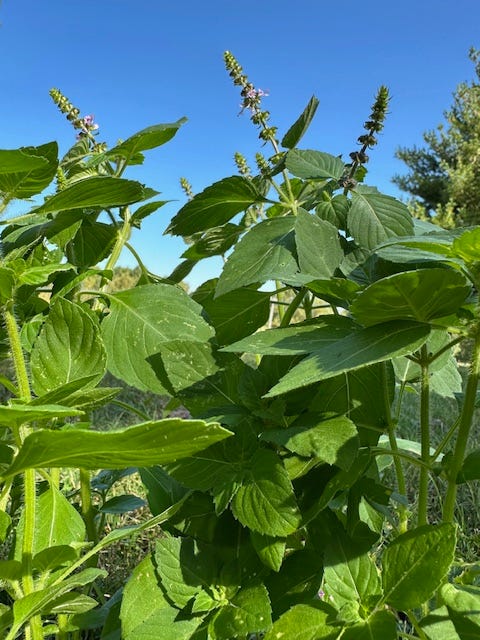
Analyses reveal that the essential oils of O. Africanum, the temperate or “Kapoor” Tulsi freely cultivated in the U.S.A., contains less, but still a good deal of eugenol, and lower amounts of the problematic methyl eugenol, and more of the estragole that is prominent in sweet basil, O. basilicum. This plant also offers the rosemarinic acid, apigenen, ursolic acid, and flavonoids which render so many of the salutory effects associated with holy basil. Owing to its citral constituents it smells and tastes fantastic. This plant is more of a daily driver, since its proportion of potentially problematic constituents is lower than the more medicinal strains of O. tenuifolium.
The differences between food, medicine and poison is the dose. This is the north star of maintaining health through what we eat, amid the onslaught of fear porn generated about plants that have been our food, spice, and medicine since pre-history.
Most people have heard of chia seeds, and psyllium seed, but not basil seeds. Basil seeds, a.k.a. sabja or tukmaria, are widely used in South Asia as a nutritious drink which contributes demulcent qualities, fiber, minerals and fatty acids to the diet. This product is usually produced from certain types of sweet basil, Ocimum basilicum. In India the sweet basil growing in the north is called marua, and in the south it is called rudrajada. Most sources clearly distinguish this sweet basil from holy basil. However, one can find such products called holy basil seeds sold for edible use on Amazon and Etsy. These have conflicting labels and descriptions, and are likely the seeds of sweet basil varieties. If you get a chance to see the mechanized harvest of sweet basil, you’ll observe mown tops of the plants deposited in huge bins and carted off by the truckload. Mass harvesting of these plants, particularly where they are perennial, can’t be synchronized perfectly, so what’s going to collect at the bottom of the bins? Zillions of tiny, hard, brown seeds. Shame to waste!!! Those seeds have become a popular nutritional supplement in many parts of the world.
In India, the holy basil is grown in gardens and pops up everywhere. So it’s not in such massive agribusiness production as one might think it would be, and therefore you are not as likely to find huge aggregates of seeds that can be bagged up and sold as palliatives for the digestive tract. Nevertheless, holy basil seeds have been utilized as a source of demulcent mucilage, like the seeds of sweet basil. Traditionally they have been used to soothe ulcers, diarrhea and vomiting. Anti-oxidant effect and anti-inflammatory effects are attributed to linolenic acid found in both sweet and holy basil seeds. They are a source of prebiotic fiber. Like other good sources of fiber, they’ve been credited with toning the gut flora, encouraging weight loss, and stabilizing blood sugar.
Preparing basil seeds
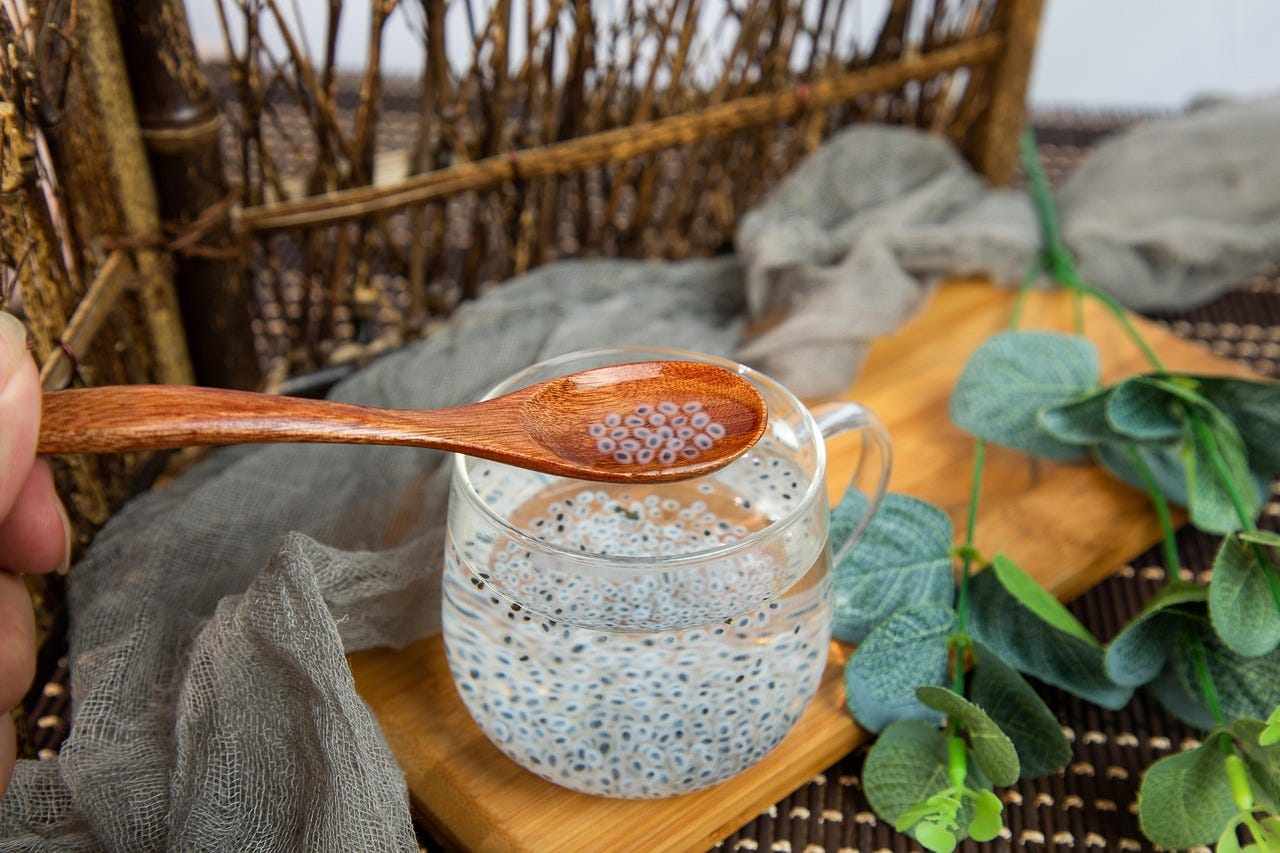
Using a fine strainer, quickly wash basil seeds to remove any foreign material. The seeds must be placed in warm water, then allowed to soak, for 30 minutes to preferably several hours until they expand to form gelatinous pearls with dark centers. (They truly look like tiny fish eggs when ready to drink.) A half cup of warm water will hydrate about 2 teaspoons of basil seeds fully. The hydrated seeds can then be mixed with lemon, calamansi, or mango juice for a drink, or mixed with yogurt and consumed as a pudding.
Zen Basil is a Sabja seller which has gone to war, claiming that the Holy Basil seeds can’t be eaten and are not safe. The company cites a publication of the Norwegian Institute of Public Health, a risk assessment of O. tenuifolium, which discusses constituents of the whole plant, though most have not been demonstrated as being present in the seeds in appreciable quantities. The conclusion is that the holy basil seeds are unsafe for consumption, because they have not been proven to be safe, citing all the compounds that people have been eating with sweet basil and consuming as tea and medicine with holy basil :-D. Now the biggest bogeyman of holy basil is the beastly, potentially carcinogenic, methyl eugenol. But sadly for Zen Basil Company the essential oil of sweet basil is full of estragole, (of similar carcinogenic potential) which adds wonderful anise like overtones to the flavor of this herb. Folks at the European Medicines Agency suggest that adult humans should limit themselves to 0.5mg daily of this ubiquitous herbal constituent. Therefore Zen’s sabja exists under a similar western pall of “toxicity” that the company wished to confer upon holy basil seeds. However the Zen Basil company could be correct that much of what is sold as “holy basil seeds” (Carrington, Rani and possibly Yuvika, for examples) are mis-labeled. They might be selling a type of sweet basil (O. basilicum) seeds.
In reality, the greatest danger coming from basil seeds is if they are consumed dry, with insufficient liquids, and produce an obstruction in the G.I. tract, as has occurred with the incorrect use of psyllium, which is sold at almost every drug store in the U.S.. Drinking down a tablespoon full of basil seeds, that have been properly hydrated to fish egg configuration in a glass of water, is very unlikely to bring about disaster. Some may experience issues with the texture, but it’ll be no problem at all for okra eaters. Those who are especially sensitive to plant lectins might prefer the basil seeds over chia seeds as a fiber source.
Wandering the world of Tulsi literature for about a month has pulled up amazing stories. My current favorite is the program to plant Tulsi around the Taj Mahal in order to help save the structure from the damaging effects of pollution, which have yellowed and pockmarked the exterior. The idea of planting a Tulsi green zone popped up in 2008 as a means to preserve the world famous ‘monument of love’. Among the claims that Tulsi purifies the air, (it smells great, and is a bit of a bug repellant), arose the novel idea that it produces ozone for 4 hours per day. An enzyme, cyclooxygenase, was credited with this marvelous schedule of gas production, per the Times of India. I’d give that ozone tale a big negatori, but will go with the rest of the purification story. As with many other plants, the generous root system will sequester unwanted ground pollutants. All plants are catchers of dust and particulate matter, and any green zone sequesters water, and replaces an asphalt heat sink. Plus, the idea of aromatic Tulsi claiming territory has not escaped notice :-D
Making a Glycerite
Once you have planted your Ocimum Africanum and Ocimum tenuifolium, and and they have colonized your growing space, you might have more herb than you can use. It’s time for making glycerite. This is a way to extract herbs for longer term use, particularly for people who want less or no alcohol.
You can obtain glycerin USP grade (greater than 99.5 % pure) online or from a drug store, or from a soap and cosmetic supplier. USP grade glycerin is considered FCC food grade by definition. It’s tested to ensure exclusion of heavy metals. You’ll often see both labels on the products, but sometimes not. Glycerin signifies higher purity than glycerine, which may be only 95% pure and not USP and food grade. Use glycerin USP /food grade if you are making medicine.
A glycerite, made correctly can be stored for about a year. It may last longer in a refrigerator. For stability, glycerin has to be present as 55% of the mixture. If you keep your mixture as 2 parts glycerin, and 1 part fresh herb by weight, this will usually guarantee that the final product will be above 55% glycerin. During the extraction, glycerin draws water out of the plant, which dilutes the 99.5 % glycerin with which you started. Another way to reduce water in the extraction is to chop and allow the plant material to wilt in the shade for an hour before adding it to the glycerin. That would not be necessary with holy basil. The more finely you macerate the plant, the more efficient extraction will be. Some herbalists will grind the plant material and glycerin in a blender. Expect uncrackable emulsions and very long separation times when you do that. I have stories from the research days :-D
Combine 2 parts glycerin by weight and 1 part finely cut, fresh plant material by weight. Mix thoroughly. Store the mix in a sealed labelled jar away from light. Visit it 1 or several times daily to shake it. In a week or 2, pour this into a filter cloth and squeeze it through. You’ll notice the glycerin is thinner, having taken up water from the plant. (Another method to speed up extraction is to seal your jar with plant plus glycerin, and heat it in a water bath, simmering it for an hour or so. Let it cool before squeezing the mixture through a cloth.)
Store the filtered glycerite in a jar out of the light to let it settle. Pour off, or pump off the clear liquid from the top, leaving the solids at the bottom. Running the final glycerite liquid through a cheesecloth might help .
Thoroughly label and store the glycerite away from light in a cool place.
A general rule of thumb is that 2:1 glycerite doses, made with fresh plant can be twice as much volume as ethanol tincture doses made 5:1 with dried plant. This is based on general extraction efficiency as well as the water content of the fresh plant.
I’m planting my Krishna and Rama seeds as well as temperate Tulsi seeds into some flats within a week or so. That way they’ll have a sufficiently warm place to land when I transplant them. I’ll leave a place in chat for the faithful readers to comment or ask questions about glycerin and glycerites. There are many glycerite making methodologies based upon whether dry or fresh plant is being extracted.
Holy Basil

Whether you are Hindu or not, don’t be dissing the Tulsi. It’s important. Hundreds of millions of people can tell you about the sacred and beneficial values of this plant, but at weedom you get a little chemistry as a bonus.
Where We Dig
1. Zhang X, Felter SP, Api AM, Joshi K, Selechnik D. A Cautionary tale for using read-across for cancer hazard classification: Case study of isoeugenol and methyl eugenol. Regulatory Toxicology and Pharmacology. 2022;136:105280. doi:10.1016/j.yrtph.2022.105280
2. Bhattarai K, Bhattarai R, Pandey RD, Paudel B, Bhattarai HD. A Comprehensive Review of the Phytochemical Constituents and Bioactivities of Ocimum tenuiflorum. ScientificWorldJournal. 2024;2024:8895039. doi:10.1155/2024/8895039
3. A Public Warning: “Holy Basil Seeds” Are Not Edible — And Americans Deserve to Know the Truth — Zen Basil | Organic Basil Seeds | High Fiber Superfoods. Zen Basil. November 4, 2025. Accessed March 30, 2026. https://zenbasil.com/blog/a-public-warning-holy-basil-seeds-are-not-edible-and-americans-deserve-to-know-the-truth
4. Calderón Bravo H, Vera Céspedes N, Zura-Bravo L, Muñoz LA. Basil Seeds as a Novel Food, Source of Nutrients and Functional Ingredients with Beneficial Properties: A Review. Foods. 2021;10(7):1467. doi:10.3390/foods10071467
5. Joshi RK, Hoti SL. Chemical composition of the essential oil of Ocimum tenuiflorum L. (Krishna Tulsi) from North West Karnataka, India. Plant Science Today. 2014;1(3):99-102. doi:10.14719/pst.2014.1.3.52
6. Cech R. Growing Plant Medicine. Vol 2. Herbal Reeds, LLC; 2024.
7. Groves MN. Holy Basil: The Zen Herb – Mother Earth Gardener. Accessed March 3, 2026. https://www.motherearthgardener.com/plant-profiles/holy-basil-plant-zm0z17szfis/
8. Sharma S, Rolta R, Salaria D, Dev K. In vitro antibacterial and antifungal potentials of Ocimum tenuiflorum and Ocimum gratissimum essential oil. Pharmacological Research - Natural Products. 2024;4:100065. doi:10.1016/j.prenap.2024.100065
9. Cech R. Making Plant Medicine. Fourth edition. Herbal Reads; 2016.
10. www.wisdomlib.org. On the method of worship of Tulasī Devī [Chapter 25]. May 15, 2013. Accessed March 4, 2026. https://www.wisdomlib.org/hinduism/book/devi-bhagavata-purana/d/doc57338.html
11. Malav, P, Pandey A, Bhatt K, Bisht I, Krishnan S. (PDF) Morphological variability in holy basil (Ocimum tenuiflorum L.) from India. Genetic Resources and Crop Evolution. 2015;62:1245-1256. doi:10.1007/s10722-015-0227-5
12. Nisar MF, Khadim M, Rafiq M, Chen J, Yang Y, Wan CC. Pharmacological Properties and Health Benefits of Eugenol: A Comprehensive Review. Oxid Med Cell Longev. 2021;2021:2497354. doi:10.1155/2021/2497354
13. Mulugeta SM, Pluhár Z, Radácsi P. Phenotypic Variations and Bioactive Constituents among Selected Ocimum Species. Plants (Basel). 2023;13(1):64. doi:10.3390/plants13010064
14. Steffensen IL. Risk Assessment of Holy Basil (Ocimum Tenuiflorum L. and Ocimum Sanctum L.) and Some of the Component Substances Used in Herbal Teas and Food Supplements. Norwegian Institute of Public Health; 2023. Accessed March 31, 2026. https://www.fhi.no/contentassets/f08343d5155e413284f5c31a6b415b51/fhi-report-holy-basil-271123.pdf
15. Jamshidi N, Cohen MM. The Clinical Efficacy and Safety of Tulsi in Humans: A Systematic Review of the Literature. Evid Based Complement Alternat Med. 2017;2017:9217567. doi:10.1155/2017/9217567
16. Bhamra SK, Heinrich M, Johnson MRD, Howard C, Slater A. The Cultural and Commercial Value of Tulsi (Ocimum tenuiflorum L.): Multidisciplinary Approaches Focusing on Species Authentication. Plants (Basel). 2022;11(22):3160. doi:10.3390/plants11223160
17. Liu WN, Shi J, Fu Y, Zhao XH. The Stability and Activity Changes of Apigenin and Luteolin in Human Cervical Cancer Hela Cells in Response to Heat Treatment and Fe2+/Cu2+ Addition. Foods. 2019;8(8). doi:10.3390/foods8080346
18. Tulsi (Holy Basil) Type Comparisons. Richo’s Blog. April 19, 2017. Accessed March 3, 2026. https://blog.strictlymedicinalseeds.com/tulsi-holy-basil-type-comparisons/
19. Tulsi has environmental benefits too - Times of India. Accessed March 31, 2026. https://timesofindia.indiatimes.com/home/environment/flora-fauna/tulsi-has-environmental-benefits-too/articleshow/12574905.cms
20. Yadav R, Fatima SK, Dhawan SS. Unlocking the medicinal potential of Ocimum africanum: A review of its phytoconstituents and pharmacological activities. South African Journal of Botany. 2025;184:617-630. doi:10.1016/j.sajb.2025.06.020
21. Use of herbal medicinal products containing estragole - Scientific guideline | European Medicines Agency (EMA). November 23, 2005. Accessed March 30, 2026. https://www.ema.europa.eu/en/use-herbal-medicinal-products-containing-estragole-scientific-guideline
22. Pisutthanan N, Pisutthanan S. Variability of essential oil constituents of Ocimum africanum. Naresuan University Journal. 2009;17(3):269-274. https://www.thaiscience.info/journals/Article/NUJ/10896574.pdf
23. Jan 7 U:, 2019, Ist 13:40. What are sabja (basil) seeds? Their health benefits and tips to eat. BombayTimes. Accessed March 31, 2026. https://recipes.timesofindia.com/what-are-sabja-basil-seeds-their-health-benefits-and-tips-to-eat/articleshow/65054694.cms
24. Fuller NJ. Yield and Essential Oils of Holy Basil (Ocimum Tenuiflorum l., o. Gratissimum l.): Varietal Comparison and Analytical Methods. University of Georgia; 2017. Accessed March 28, 2026. https://openscholar.uga.edu/record/11116
I love basil, even though it is difficult to get started in my zone 3 location. The bumble bees absolutely *love* the flowers, and each stalk is typically loaded with bees when they are in full bloom. Have you ever found a way to successfully dry basil and keep it green? Mine always turns brown no matter what I've tried. It seems that the good smell and taste disappears as well when I dry my own. Thanks!